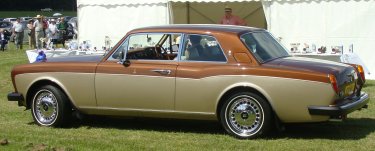
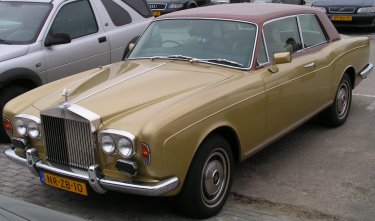
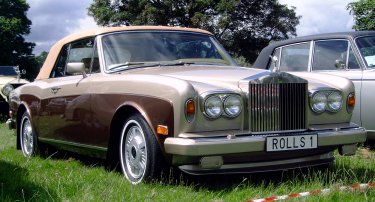
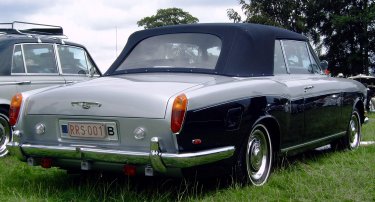
The two-tone colour scheme or dual paint scheme was very popular in the sixties and seventies. In the eighties the popularity decreased quickly and in the nineties the schemes hardly occured any more.
This colour scheme in which almost all colours could be combined, could be ordered at no extra cost. There was one rule: acrylic paints could only be combined with acrylic paints because of the type of primer that was used.
When a customer liked a two-tone colour scheme, Rolls-Royce recommended to make the dark colour the lower colour of the two. But the customer was free to order the other way around and that often happened.
The wheel discs incorporate a vanity ring which was normally finished in the lower body colour when a two-tone colour scheme was specified.
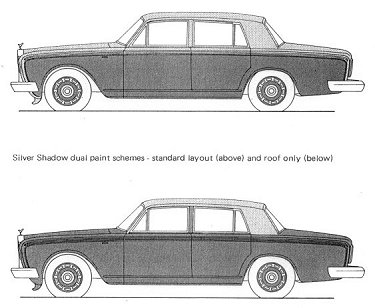
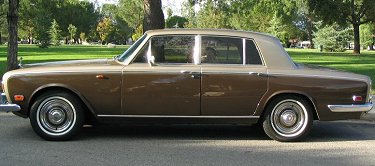
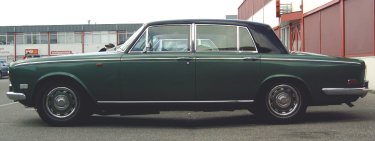
When two-tone colour schemes were applied in a standard lay-out, the colours were separated on the body fold near the side moulding. This standard lay-out is shown on the first picture below. As can be seen it was also possible to choose for a roof only colour scheme. This last colour scheme is rather rare.
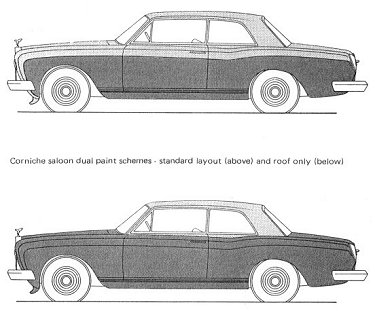
A Silver Shadow Mulliner Park Ward and a Corniche could also be delivered in a two-tone colour scheme. Because the waistline differed from the line of the standard saloon, the colour separation line reached to the rear lights unit.
The convertibles too were often provided with a two-tone colour scheme. The roof only scheme couldn't be applied to this kind of body.
|
 Marinus Rijkers. Disclaimer